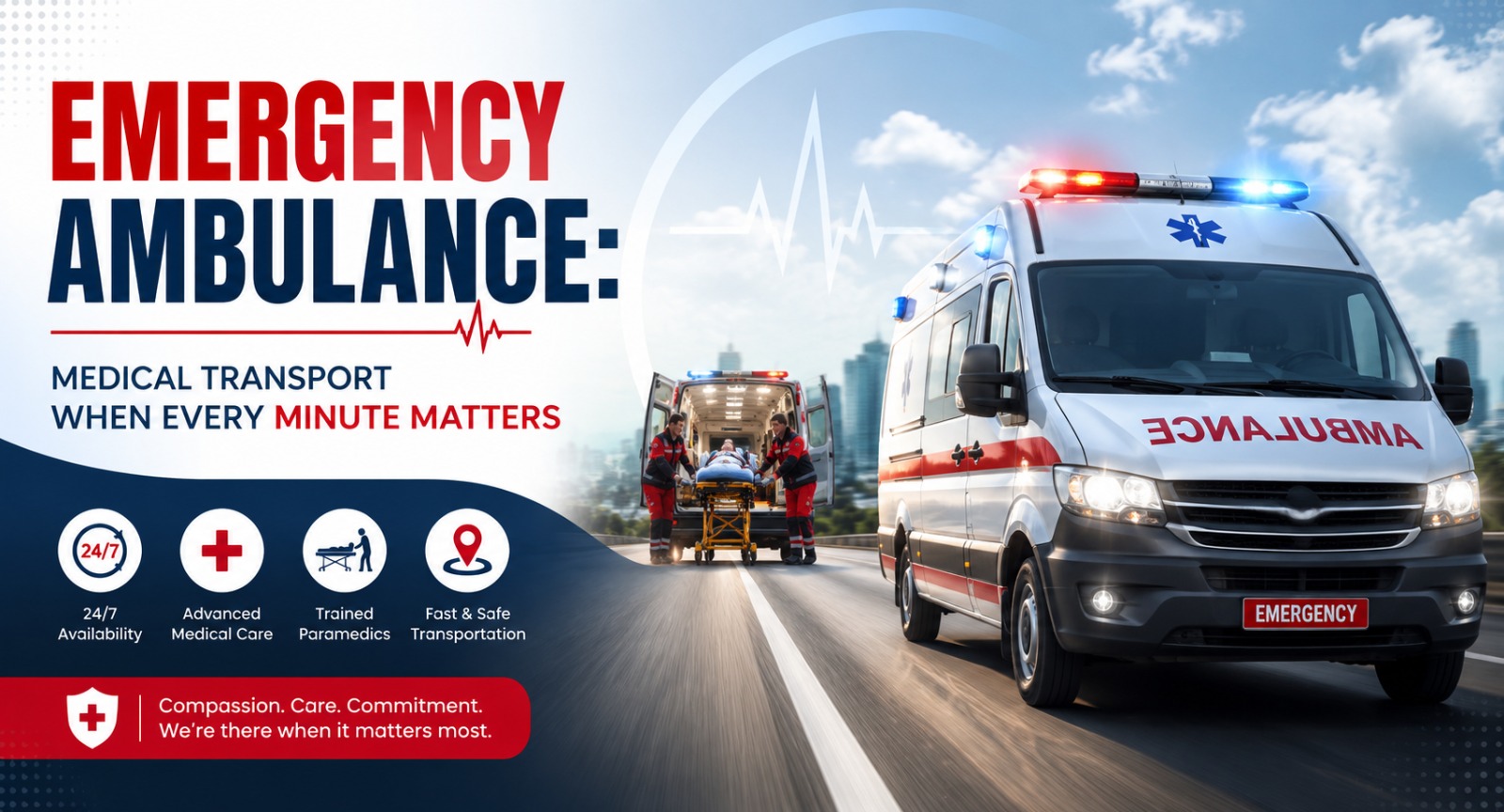
Emergency Ambulance: Medical Transport When Every Minute Matters
What Is an Emergency Ambulance?
An emergency ambulance is a specialized medical transport vehicle that is designed to facilitate quick transport of individuals who are experiencing serious medical conditions or life-threatening situations.
An ambulance can give medical assistance during transport to a suitable health care facility, unlike other modes of transportation. It can contain oxygen, monitoring equipment, emergency medicines, stretchers and other necessary medical supplies depending on the type of ambulance.
Medical personnel can also be trained to evaluate patient status during transport and be able to provide the necessary care. This helps to make an ambulance an important component of emergency healthcare since treatment may not need to be delayed until arrival at the hospital.
Ambulance services in India are supported by the government and comprise emergency responders, of which 108 is the service that is mainly used for critical care, trauma and accident cases.
How Emergency Ambulances Support Patients
The greatest benefit of an emergency ambulance for medical transportation is that it links a medical emergency with medical care in a timely fashion. Considered as a temporary link between the place of an emergency and a hospital.
If a person sustains a serious injury, has difficulty breathing or becomes unconscious, or develops an urgent condition such as serious bleeding, the act of moving the person without adequate support may sometimes pose secondary risks.
Ambulance personnel are trained to handle patients in a careful manner and are able to utilize proper equipment when transporting patients. They are also able to relay pertinent information to the receiving medical facility if needed. So, it is better to call an ambulance than to try to drive a seriously ill person.
When Should You Call an Emergency Ambulance?
During an emergency, it is important to know when to call an ambulance. Sometimes the hesitancy comes from uncertain on seriousness. But when the person looks very sick or hurt, it’s usually better to call for professional emergency help rather than expect symptoms to get better.
Conditions that arise such as unconsciousness, serious breathing difficulties, major injuries, heavy bleeding, chest pain, suspected stroke, serious burns, significant accidents, or any immediate medical attention may be required.
The same can happen when a child is involved in an emergency, for elderly persons or vulnerable patients, too. The principle is that it is important not to delay unnecessarily when there is a life-threatening situation.
Common Situations That Require Immediate Help
An ambulance may be needed for those who have experienced:
- Shortness of breath or severe trouble breathing
- Loss of consciousness or sudden confusion
- Serious injuries following a road crash.
- Severe or excessive bleeding
- When chest pain is severe or a cardiac emergency is suspected.
- Suspected stroke symptoms
- Significant burns or injuries.
- Severe allergic reactions
- Toxic or other exposures that could be harmful.
Always this is a matter of circumstances and the seriousness of the symptoms. In an emergency that might prove deadly, it is better to call an emergency number than normal transportation.
What Services Are Available Inside an Ambulance?
The way emergency ambulances can differ depends on their equipment and medical needs. A basic ambulance may be designed to primarily transport patients safely and provide basic first response care. Scooters such as those in use by more advanced ambulances are able to offer advanced monitoring and life-support equipment for more seriously ill patients.
Advanced Life Support (ALS) ambulatory vehicles, Basic Life Support (BLS) ambulatory vehicles, patient transport vehicles and other emergency response vehicles are the Government-supported National Ambulance Services in India. The difference matters because not all patients need the same amount of medical assistance.
Basic and Advanced Medical Support
The Basic Life Support ambulances are usually equipped with the necessary equipment to stabilise and transport patients. Advanced Life Support ambulances are used to transport patients who might require more advanced monitoring and emergency care as they are being transported.
Equipment can range from oxygen delivery systems, patient monitors, stretchers, emergency medical supplies, and other medical devices. Experienced staff are able to observe the patient and act on changes throughout the travel. Therefore, choosing the right ambulance may be as vital as speedy transport to the hospital.
Emergency Ambulance Number in India
People need to know that in India the availability of ambulance services may vary from state to state and location to location depending on the emergency ambulance number in India. The Ministry of Health and Family Welfare, however, has said that National Ambulance Services are available with dedicated toll-free numbers like 108 and 102 in many states and Union Territories.
The 2024–25 annual report from the Ministry indicates that 108 is mainly an emergency response service for critical care, trauma and accident patients, and 102 is mainly for patient transportation, especially for pregnant women and children.
Emergency systems may vary from area to area, so individuals should familiarise themselves with the emergency telephone numbers in their area before the emergency occurs. It is important to contact the appropriate emergency service immediately if the situation is immediate life threatening. Be prepared with the location and provide a clear description of the patient’s condition to the call operator.
How to Prepare Before the Ambulance Arrives
The next few minutes are stressful after an ambulance has been called. However, it is important to remain calm to help you give helpful information without any confusion. Clearly communicate the exact location, nearby landmarks, the patient’s condition, and any immediate danger at the scene.
Keep the patient’s identification and pertinent medical information available whenever possible. Avoid unnecessary movement of a seriously injured person unless this means a danger to life: this applies in particular after a major accident. Rather, obey directions given by emergency officials.
Information You Should Share
When calling emergency services attempt to find out:
- Spatial location and local landmark.
- Age of patient (if known)
- The primary symptoms or type of injury.
- Whether the patient is conscious or not
- Whether the patient is breathing normally or not
- Details of any accident or injury
- Any immediate environmental danger.
Clear information enables emergency responders to understand what is going on before arriving at the patient’s location.
Read Related: Air Ambulance Cost in India: Complete Guide to Pricing & Services
Choosing the Right Emergency Ambulance Service
If time permits, the best choice for an emergency ambulance is not just the nearest one. The ambulance support needs should be based on the patient’s medical condition. In some cases, an ill patient may need specialized equipment and trained personnel; in some other cases, the ill patient may need basic transportation.
There are many things to consider such as equipment, response, staff qualifications, vehicle condition, and hospital coordination. Reliable ambulance service should focus on patient safety throughout the journey rather than treating transportation as simply a trip from one address to another.
Why Medical Equipment and Trained Staff Matter?
Especially during transportation, when a patient’s condition changes, medical equipment is important. Medical staff will be better prepared to deal with emergency developments by having oxygen on board, monitoring equipment, emergency supplies, and proper patient handling equipment.
Meanwhile, equipment is only valuable as long as it is operated correctly by trained personnel. In this sense, it is believed that there is a better response capacity in case of emergency if there is adequate equipment and trained medical personnel available.
Emergency Ambulance for Different Medical Situations
There are lots of other emergency medical conditions that an ambulance can help with. Road accidents are one clear instance as the injured patient could need careful moving and expedient evaluation at the hospital.
In addition, those who have severe breathing issues, suspected cardiac events, neurological emergencies, severe injuries, or other serious issues might be better transported by professionals.
Ambulance support is also crucial when it may be difficult or unsafe to move a patient in a private car. A controlled environment is available during the patient’s journey to definitive care by the right ambulance.
Accidents, Heart Problems, and Other Emergencies
Unnecessary movement can be detrimental to some injuries in the event of a major accident. Ambulance staff are able to employ suitable patient handling techniques and equipment, depending on the circumstances.
Rapid access to professional care is especially valuable in suspected cardiac or neurological emergencies, necessitating timely medical evaluation. Ambulance preparedness is also a factor in emergency preparedness when it comes to extreme heat events, for example, where health authorities call for preparedness in response.
Benefits of Professional Ambulance Transportation
The advantages of professional ambulance transportation are clearly noticeable.
During critical emergencies, the services of a professional ambulance have a few practical benefits. First of all, it provides a specialised medical space and not an ordinary car! Second, the trained personnel can provide first-response care in line with their ability to provide care during the transportation of the patient.
Thirdly, ambulances are built for patients who cannot sit or travel normally. Last but not least, emergency ambulance services can more efficiently link with hospitals and healthcare facilities. These benefits are particularly significant when every minute counts, and the patient’s health status could be rapidly changing.
Conclusion
An emergency ambulance is not just a means of getting a sick or injured person to hospital. It’s a vital step in the continuum of care from the emergency scene to professional healthcare. Awareness of when to call and the knowledge of available services and the emergency ambulance number in India can enable people to respond with confidence during critical situations.
National Ambulance Services in India are special emergency response and patient transport services that are established in the country with most of the services from the 108 providing critical care, trauma care and accident services in many parts of the country.
In case of a serious emergency, remain calm, give precise information, adhere to the instructions of the operator of the emergency centre and obtain appropriate medical help without unnecessary delay.
FAQs About Emergency Ambulance
1. What is an emergency ambulance?
An emergency ambulance is a medical transport vehicle equipped to support patients during urgent situations. Depending on its category, it may provide basic or advanced medical assistance during transportation.
2. What is the emergency ambulance number in India?
Government-supported ambulance services use dedicated numbers in many parts of India. The Ministry of Health and Family Welfare identifies 108 primarily with emergency response for critical care, trauma, and accidents, while 102 is mainly associated with patient transportation services.